
Two BCI Events, One Goal
Foundation Models for the Brain got experts talking. Global NeuroHack got students building. We supported both.


The last month has been exciting. We supported two events on different sides of the US. At the end of March, we partnered with NeuroNYC to organize an evening symposium on Foundation Models for the Brain, hosted by the law firm Brown Rudnick amid New York City’s famous skyline. Two weeks later, San Francisco’s Frontier Tower hosted the Global Neurotech Hackathon, organized by the Imperial Neurotech Society and NeuroTechX. We sponsored one of the hackathon’s three tracks, on non-implantable speech decoding, challenging five teams of students to impress us with their approach.
The two events may seem quite different. Foundation Models for the Brain was a gathering of established experts, with a wide-ranging set of concerns. Global NeuroHack’s teams were young: many were undergraduates. And in the few days they had to build, they were laser-focused.
But between the two events was one core mission: supporting the brain decoding community. We got senior academics and neurotech leaders talking about some of the biggest challenges in an incredibly promising area. And we got young talent learning from mentors, refining concepts, and exploring exciting ideas. By getting the community talking and thinking, we’re accelerating progress, getting everyone closer to the scalable solutions we need.
Foundation Models for the Brain
At our evening symposium in NYC, one approach to scalability, foundation models, took center-stage.
Foundation models represent a new approach to understanding and decoding the brain. The hope is that with enough data, researchers can train models that are not just powerful, but generalizable: able to go beyond their training data, and work in new situations. It’s an approach that may be enormously important for developing truly versatile BCI.
After a few opening remarks, our first panel focused on the bottlenecks holding back this approach. Moderated by Patrick Mineault of the Amaranth Foundation, the panel gathered Vinay Jayaram from Alljoined, Andreas Tolias from Stanford, John Crary from Mount Sinai, Liam Paninski from Columbia, Cole Hurwitz from IBM, Marcelo Mattar from NYU, and David Moses from UCSF. One of the biggest themes of the discussion was data. Foundation models are data-hungry, but on top of worries about acquiring enough data, participants wanted to make sure we gathered the right data. That could mean data that takes into account the context the measurements were taken, to make models that generalize better to the real-world, but it could also mean data that avoids hand-made labels that could build in limiting expectations. Overall, there was a feeling that being smart about what data the field uses can go a long way.
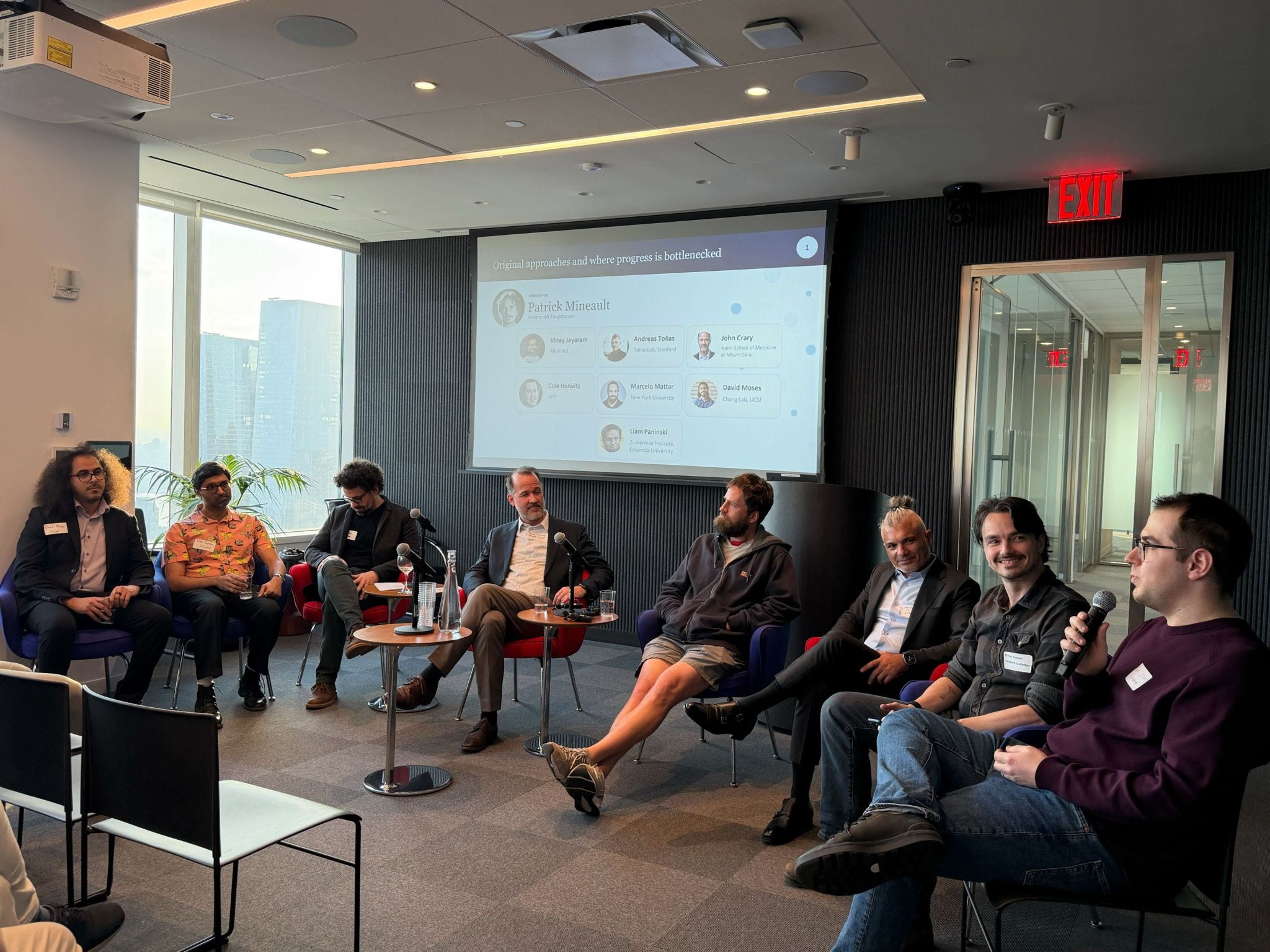
The second panel of the evening brought together members of the funding ecosystem. Moderated by Sean Escola of Protocol Labs, the panel included Dimitris Sakellariou from Piramidal, Mariam Khayretdinova from Brainify, Qingyu Zhao from Weill Cornell, Joe Futoma from Oura, Eric Trautmann from Meta Reality Labs, and Surya Ganguli from Stanford and General Catalyst. Panelists discussed the unique funding challenges faced by neurotech, which often needs more time than the 5-10 year timeframe where most VCs want a return, while going beyond the scope of traditional grantmaking, leading to a frequently mentioned “valley of death” effect. In practice, the field’s funders are almost always true believers, who see neurotech’s potential in a way that others don’t.
A few rapid-fire polls read the room. Participants favored better sensors over more data as a way to advance the field, and were more split about whether it was best to optimize models across individuals, or across contexts for one individual.
A keynote from Andreas Tolias, titled “A Less Artificial Intelligence,” focused on the other side of the question: how better models of the brain could inform AI, by uncovering the principles behind natural intelligence. It was a prime example of the wide-ranging nature of the event, bringing together people with a variety of goals into productive conversation.
As the evening closed, conversation was in full swing. The event ended with a reception, where groups met in breakout sessions to discuss more specific topics. Neuroethicists and law experts talked about what governance should look like in the NeuroAI ecosystem. Researchers discussed the signal requirements for decoding motor control on the scale of the whole body, covering a variety of tradeoffs in the needed training data, including whether they should aim to measure intentions or actions. One group focused on EEG, where a key question was whether it was possible to gather enough consumer data, which depends in turn on whether there are BCI applications useful enough that enough people will be eager to adopt them. Data quality was a major topic, and there was broad agreement that better data was more useful than more low-quality data, and that it was important to have data that could generalize across tasks.
As night fell over NYC, the conversations continued. Protocol Labs sponsored post-reception drinks in a rooftop bar around the corner, and afterparties stretched into the early morning, with free-wheeling 5am chats.
The Global Neurotech Hackathon
Early-morning chats were a feature of Global NeuroHack too, though of a busier kind.
The event took place over three days, facilitated by organizers from not just Imperial College London, but universities around the world. Over one hundred students participated, attending workshops from expert mentors before they plunged into a 48-hour rush to build something extraordinary.
In our track, we challenged the students to build something that’s been on our minds lately: a system to take brain data gathered from non-implantable sensors and get out structured communication, like text. The students could use public datasets, but they also had the opportunity to gather data directly, with EEG and fNIRS headsets that they had access to thanks to the Hackathon’s sponsors. We helped recruit mentors, like David Moses and Anshul Kaashyup, to give the students the best start we could.
The results exceeded our expectations.
The winning team, CereBro, brought together students from the École Polytechnique Fédérale de Lausanne and the National University of Singapore. Showcasing the power of brain foundation models, they built a fine-tuning pipeline that linked together multiple EEG backbones into a single end-to-end system to decode inner speech. Their project impressed us with its high technical depth, an amazing accomplishment in such a short amount of time. The hackathon was great for the team as well, with David Zhang, the team’s NUS member, commenting that it was an “absolutely amazing experience, it’s a privilege to have this opportunity to compete alongside some of the most talented students and receive guidance from the best experts in the neurotech field.”
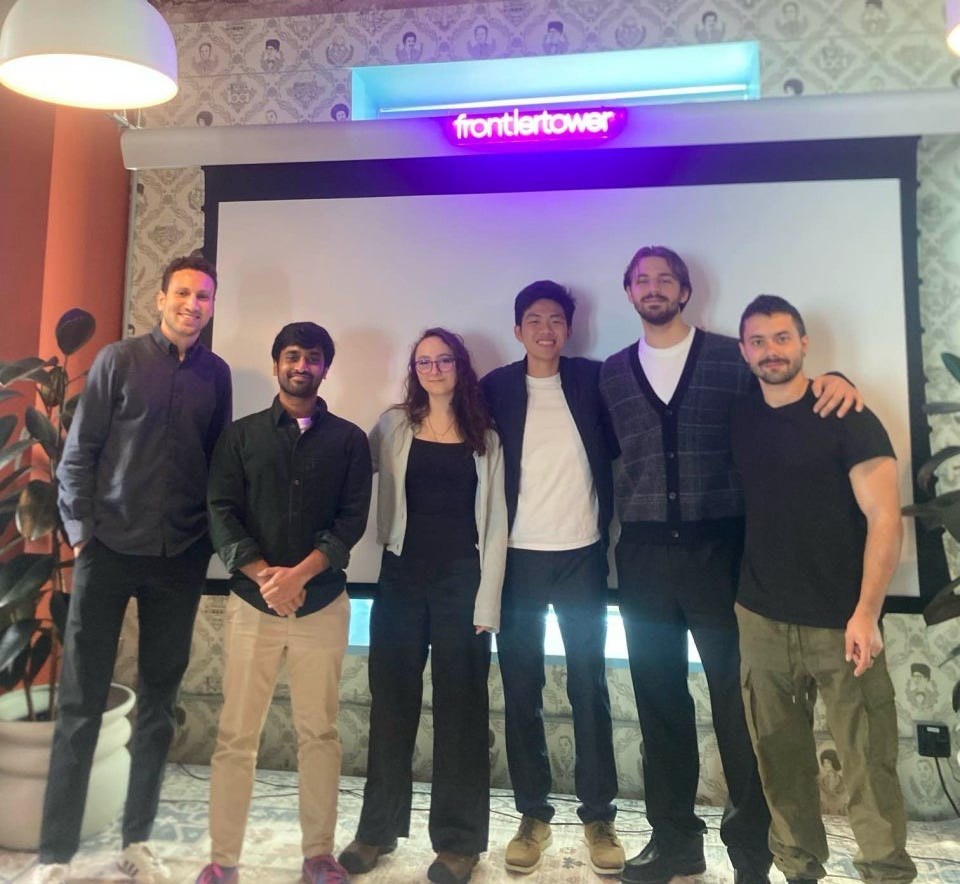
The second-place team, FABLE, displayed stunning creativity. Composed of students from UT Austin’s Longhorn Neurotech, FABLE prototyped a BCI-powered fairytale storybook, using EEG and narrative context to decode a story in real-time. They envision their system as a tool for aphasia recovery and language acquisition, helping those who struggle with language to grasp at what they mean to convey.
The rest of the event was full of amazing ideas as well. One team proposed vagal nerve stimulation for cows. Another, a safety app using EEG wearables, that got the team out into the street asking if passers-by wanted to join their “hivemind”. Others built anti-anxiety glasses, envisioned genetically engineering light-sensitive neurons, and built a neural spike-based guitar hero clone.
Overall, we were impressed by the students’ eagerness and drive to learn. None of the teams were scared to ask questions, and they took full advantage of the opportunity to meet with mentors and representatives from neurotech companies. It was an immensely dynamic and rewarding weekend.
Fielding-Building, not just a phrase
We have a tab on our website called Field-Building. It’s a term that may be unfamiliar to people outside of the worlds of funding and activism. But it’s more literal than it looks. Field-building is what we do to build research fields. Not from scratch, of course…but bigger, and better.
That research is the first step. We get experts talking, and students learning, because we want the world’s most talented minds focused on the problems that matter most. We want a world full of people who address tough challenges and find ways to make progress. We want to encourage the kind of people and ideas that shape an environment where new things can be built.
David Moses was one of the expert panelists talking at Foundation Models for the Brain, and mentored students at Global NeuroHack. He had this to say about the events:
“It’s a pleasure to be part of the community that e184 is fostering. I expect great things to come from this interdisciplinary group as we each contribute to the advancement of neurotechnology and neuroAI!”
We’re proud to have supported so many great conversations in this community, both at Foundation Models for the Brain and at Global NeuroHack. We can’t wait to see what you all build next.